
The flight from reality
Review of "The Persistence of the Ideological Lie: The Totalitarian Impulse Then and Now"

For violence has nothing to cover itself with but lies, and lies can only persist through violence. — Aleksandr Solzhenitsyn
During the height of the Black Lives Matter hysteria in 2020, Detroit Mayor Mike Duggan ordered the removal of a 110-year-old statue of Christopher Columbus from a spot near City Hall. He was goaded into action by a group called the Raiz Up collective that characterized the explorer as a genocidal murderer, slaver and plunderer. “Together,” intoned the Columbus detractors, “we can change our culture and our consciousness. In new awareness we can find ways to restructure those paradigms that lack equity, and create new ones that empower our own communities with the knowledge of self.”
The petition to remove Columbus from public space was founded on a contested scholarship that saw him not as the celebrated discoverer of the New World but the first in a long line of European despoilers of an edenic North America and its native cultures. Columbus was, in fact, pulled down and put into storage to serve an ascendent wokeness, specifically an anti-colonial ideology.
In a new collection of essays titled “The Ideological Lie — The Totalitarian Impulse Then and Now”, political philosopher Daniel J. Mahoney lays bare the twisted ideologies — theories, concepts, axioms, abstractions and, yes, paradigms — undergirding political and social movements that, in the not so distant 20th century, turned deadly and even genocidal on a scale previously unimaginable to those who witnessed it unfold. Many of these same ideologies are with us still.
A scholar of the works of Aleksandr Solzhenitsyn, Mahoney shares the Russian writer’s understanding that ideology “presented evildoing as a historically necessary stage in the fated ‘progress’ of the human race.” Solzhenitsyn always asserted that “the Ideological Lie was worse than violence and physical brutality, ultimately more destructive of the integrity of the human soul.”
Mahoney’s aim with “The Ideological Lie” is for the book to serve as “an exercise in practical reason and applied political philosophy and not an ‘ideological’ response to equally ungrounded ideological assertions. It follows that the best critics of the totalitarian Lie, especially those from behind the Iron Curtain, who saw in ideology a mendacious assault on decent politics and the human soul. To oppose the ideological deformation of reality is at the same time to affirm to goodness of the created order.”
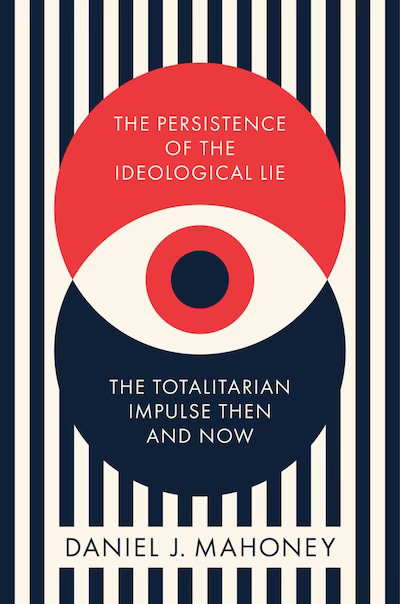
A dozen essays range across topics such as “woke despotism,” Marx and Marxism, the aftermath of the 1989 collapse of communism, the execrable 1691 Project, and the French Revolution. These are both topical and timeless. That is, the essays expose the strains of utopianism, deceit, and the power-mad nature of those who knew exactly how to perfect imperfect man going back to movements such as those animated by the Jacobins or the Bolsheviks. Mahoney gives the reader an entire chapter on Solzhenitsyn’s determined effort to expose the Ideological Lie embedded in Soviet totalitarianism. Mahoney concludes the book with an exhortation to moral courage and moderation, qualities too often found in short supply today, and an appeal to the political left, center and right for a return to civic sanity.
Each chapter is appended with suggestions for further rreading and a final end note offers a list of “Ten Essential Books for Understanding and Overcoming the Ideological Lie.” This collection, at 139 pages, is a primer of sorts on political theory and political culture which is why I think it would make an excellent gift for any bright and inquisitive college student. Put it to work in a book reading circle and explore some of the suggested readings. I am indebted to Mahoney for the citation of Nigel Biggar’s 2023 book “Colonialism: A Moral Reckoning” which, alas, came too late for the eduction of Mayor Duggan.
Surveying a broad sweep of thinkers including Solzhenitsyn, Leszek Kolakowski, Pierre Manent, Michael Polanyi, Thomas Aquinas and John Henry Newman, Mahoney explains how the Ideological Lie rests on an upside down moral framework. “The morally inverted, the ideologically fanatical, combine deep moral skepticism with the justification of the truly unjustifiable, such as revolutionary terror and unprecedented forms of tyranny ... Polanyi observed that the ideologist (and fellow traveling intellectuals more broadly), act with the ‘whole force of his homeless moral passions within a purely materialistic framework of purposes.’”
The Ideological Lie is not counterbalanced by yet more ideological propositions but by an authentic Christian realism. This is what Solzhenitsyn was telling us when he said, in what may be the most succinct formulation of that realism, that the “line dividing good and evil cuts through the heart of every human being. And who is willing to destroy a piece of his own heart?”
Mahoney:
Real human freedom and dignity need to be nourished by a deep sense of obligation, starting with our forebears, without whom we would not be or have anything at all. Natural piety, however, is not solely focused on the past: it lifts our gaze further outside ourselves to the mysterious givenness of the natural order. It is open to the grace that lifts our spirits and allows us to experience the presence of the Living God. Only by acknowledging our considerable debts to our forebears, to ennobling tradition, and to the natural and divine sources of our dignity as human beings, are we rendered capable of achieving great and good things in our turn. In our time, humility and magnanimity, humble deference to God and legitimate civic pride, stand or fall together.
Set side by side with this moral realism, the Ideological Lie is exposed as shallow and destructive. It replaces an authentic democratic politics with its tradition of debate, compromise, and free acceptance of outcomes, with a constricting abstraction, a mental template where dogmatic assumptions and political violence are the norms. When you’re making the New Man, who has time for historical context and the dizzying contingencies of every day life?
In flight from reality, The Ideologi al Lie must partner with politics to achieve its ends. This political power recognizes few limits. And it is typically allergic to self-criticism and correction. But beware the current and incessant screeching about “saving democracy” when it is too often a cover for the Ideological Lie.
Mahoney:
Democracy, too, needs to affirm limits, constraints, hierarchies, and legitimate authority, if it is not to give way to moral anarchy, endless civil strife, and in the end, a barely concealed form of despotism.
Ideology also produces the risible, like the campaign to free chimpanzees from “detention” in a zoo in the Upper Peninsula of Michigan because the primates were denied their legal rights (no, said the court). Or the conceit that wetlands have natural rights. These are nutty ideas but they share a single aim: to denigrate the human person and elevate the material and the irrational. Nutty and dangerous.
For example, the pioneering effort to elevate the moral status of marshes and bogs and stands of cattails (accompanying duties are elided) is being led by —- scientists? And of course the “territorial stewardship”and wisdom of indigenous peoples must be respected. Here’s the tell: “As scientists have flocked to the movement in recent years, they’ve given it a new layer of credibility—and enforceability.” You may not accept that wetlands — or monkeys — have natural rights, but the law will bring you around in the end.
Pernicious ideologies corrupt the language by coining bizarre neologisms (ze/zir, xe/xim) and redefining the plain meaning of words (what is a woman?). With a nod to George Orwell, Mahoney affirms the necessary hygiene of language. “Ideology always seeks to commandeer and command language, to twist meaning for its own perfidious purposes.” Once you’ve adopted Newspeak, the Ideological Lie is halfway home. Don’t take the bait.
Mahoney concludes by demanding a rejection of the nihilistic logic of the Ideological Lie.
Only by “repudiating repudiation,” by refusing the spiritually and civically corrosive path of negation, do we have a fighting chance of again seeing the meting of wisdom and morality in our fragile and embattled civilization. But that act of moral recovery and civilizational renewal will demand an exercise of spiritual strength that will test our mettle as a free and civilized men and women.
A timely collection of essays that deserves a wide readership. Will we as a civilization find the strength for this moral recovery?
A suggestion for the Ideological Lie Book Club: The Solzhenitsyn Reader — New and Essential Writings, 1947-2005, edited by Mahoney and the late, great Edward E. Ericson Jr.
A final word from Solzhenitsyn’s The Gulag Archipelago, Part 1, Chapter 4, “The Bluecaps”
Macbeth’s self-justifications were feeble—and his conscience devoured him. Yes, even Iago was a little lamb too. The imagination and the spiritual strength of Shakespeare’s evildoers stopped short at a dozen corpses. Because they had no ideology.
Ideology—that is what gives evildoing its long-sought justification and gives the evildoer the necessary steadfastness and determination….
Thanks to ideology, the twentieth century was fated to experience evildoing on a scale calculated in the millions. This cannot be denied, nor passed over, not suppressed. How, then, do we dare insist that evildoers to not exist? And who was it that destroyed these millions? Without evildoers there would have been no Archipelago.”
Not having paid attention to why Duggan sequestered the now maligned Chris C., I go out on a limb to suggest that his move was mostly, maybe entirely, driven by political expediency, not ideology.
Maybe if the mayor had taken a full immersion in academia prior to this ostensible appeasement of the rabble, his motive might have stemmed from the latter. But that is not his background.
A call to all sides for reason in a world gone mad and heavily influenced, nay guided by invisible funding inciting "populist" often violent movements is fated to being a candle in the wind. Only those already somewhat poised to receive the plea will listen while for the majority the polemics will continue unabated.
In Combustible lexicon, it seems the wheels are gonna first have to come off this dragster on a sports car track that is the mutual linear obsessiveness of the warring factions. Only thereafter might the dust settle into saner times.